Monday, November 12, 2012

Farmer's Day 2012

The contents of this website are mine personally and do not reflect any position of the U.S. government or the Peace Corps.

December 5th is a National Holiday in Ghana.  Farmers' Day was instituted in 1984 after a severe period of drought and the reduced crops the previous year that caused food shortages in Ghana.  It was decided to recognize the hard work of the country's many farmers and the day became a National Holiday in 1995.  Each year during the run up to that day, events are held around the country to select District and then Regional candidates for the honor of being recognized by the country's President as the Farmer of the Year for Ghana. 

The display of prizes
This year the District selection ceremony was held in the village where I live.  School was dismissed in the afternoon so that we could attend.  Produce from the farms, along with the prizes for the selected farmers were displayed.  
Prizes increase in magnitude as each level of competition is reached.  At the District level prizes were; bicycles, motorbikes, beds and mattresses, farm tools, fertilizers, etc.  At the National level; the grand prize has included a pick up truck, and even a house along with being a recognized  celebrity, all carried on national TV.

Produce from the farms of this District
 In the picture the green items are bunches of plantains, larger than a banana and a staple food in
the village along with the large brown tubers which are yams and cassavas.  Bright orange are cocoa pods.  Also shown are tomatoes, corn, red hot peppers, eggs, okra, cucumbers, garden eggs and oranges.  It was a colorful display of food along with the colorful dress worn by the women and men.  

The event is sponsored by the local representative of the Ministry of Agriculture and was attended by many of the local political officials as this is an election year in Ghana.
Village Chief makes an inspection of the produce and prizes

The Village Chief attended, gave his remarks and inspected the produce as well as the prizes.   He is a highly respected leader of the village and its residents, a majority of them farmers on the surrounding land.  

This year there has been some discussion about the date of the Farmer's Day events as it is very close to election day for Ghana's President as well as other political positions.  The campaign is in full swing with lots of loud speakers making comments, plenty of posters and flags and the radio full of the latest comments by and for the candidates.  As a guest I stay well clear of the campaigning, but it is an exciting time to be in Ghana and witness their political process at work.  My fellow teachers hotly debate the issues and are proud of the noisy but peaceful process in Ghana.  

 While I am the recipient of the tasty harvest of fruits and vegetables by the farmers in this District, much still depends on the local rain fall.  I am thankful for the farmers and a good harvest as we head into the dry season.


Monday, October 15, 2012

Welcome to my residence

Area to receive visitors as you enter my three rooms
The contents of this website are mine personally and do not reflect any position of the U.S. government or the Peace Corps.

Peace Corps Volunteers coming to Ghana are provided a place to live by the local community or agency requesting their assignment.  "The identified housing should be modest and conform to the standards of the host community."  Further, the Volunteer Handbook gives these minimum standards: "Volunteer accommodation must be located within a community and must be within sight and shouting distance of at least one neighbor.  Private sleeping quarters, space for cooking and eating and access to an area to receive visitors in a traditional house, bungalow, apartment or family compound.  Mosquito screening on all windows and entrance trap doors.  A minimum of one window in each room to provide adequate cross-ventilation and light.  Ceiling or roof made of wood/straw mat/felt/rubber, metal that protects the Volunteer from the effects of heat, rain and vermin.  All doors and windows must be lockable from the inside.  Additionally, entrance doors must be lockable from the outside.  Bathing area and toilet facility with in 20 meters of the house.  If shared, should not be shared by  more than six people.  Toilets and bathing areas must provide privacy.  Minimum furnishing: one bed frame, one mattress, one table and chair.  Accommodation must always be accessible by one of the following, a 4 wheel drive vehicle, a canoe or a motorbike."

Provided bed frame, mattress and chair
My assigned residence in the community met these minimums when I arrived over a year ago.  Since I teach at the local Roman Catholic, Junior High school, the Church arranged for my housing.  I share the house with the owners niece and the two young children in her care.  Thankfully, the house is accessible by a normal automobile, has electricity most of the time, in door toilet and bathing area, but no running water.   

Like many of you, whether living in a barracks, a tent, a southeast Asia hut, a flat or an apartment, we are soon figuring out how to make our selves more comfortable and the accommodations more functional. Since the bedroom was empty except for the bed, I built the storage area you see in the picture to provide a place to hang my clothes and store other personal items.   You can also see a piece of the mosquito net all Volunteers are required to rig and sleep under.

Custom counters for the kitchen
The second room  provided was totally empty.  It has become the kitchen.  You can see the counters and shelves are pretty basic, but are very functional. The caretaker of the house now believes I am a master carpenter.   A purchased toaster oven, electric kettle and two burner gas stove allow me to test my cooking skills with local food from the market and shops.  My loss of 59 lbs during the first year of service does not say much for any pie, cake, or pastry baking skills.  Fruits and vegetables are plentiful in the market when in season; at the moment okra, tomatoes, peppers, some late corn and of course yams.   Oranges, melons and pineapples are also available.  I purchased a small frig with no freezer, but it keeps left overs and refreshing, cool water sometimes flavored with crystal lite.  

The school shop
The owner of the house allowed me to use a third room if I would repair the busted door and replace the screens on the windows.  I use  it as a work room, mostly for my Volunteer project to repair student furniture from the Junior High School where I teach.  The furniture is pretty badly damaged by the time it comes to me, with larger and larger nails being used in an attempt to stiffen the chairs and tables to make them useable.  I take all the nails out, repair and re glue the pieces, and use screws to make the piece more stable and then return to the student.  I have learned patience, how to swallow the occasional curse word, and wish I could get them finished and back into use quicker.

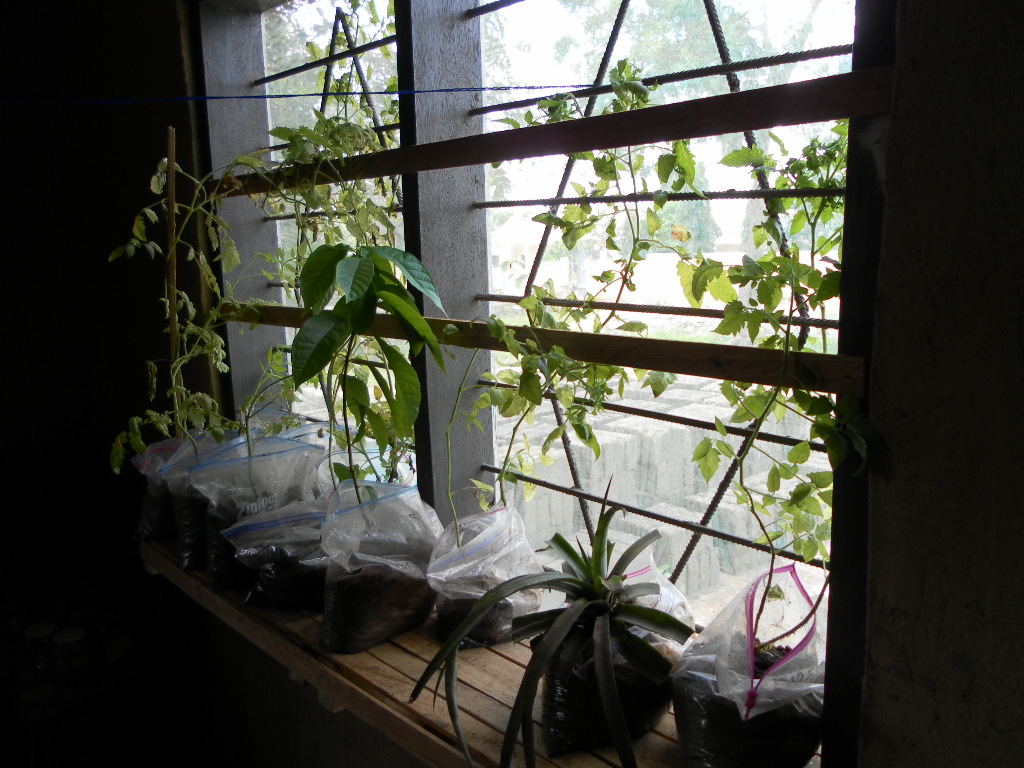
The terrace garden
 In the back window of the work room you may see my other project, an indoor, mini-garden.  Finally had to relocate from the back porch as could not keep the free range goat herds away.  I am attempting tomatoes, avocados and pineapple.   I definitely need some advice from the local farmers and have little chance for the Farmer of the Year Award this December.   It does add something green to the house and I have enjoyed the challenge of working to keep them growing.  

I am grateful for the provision of a comfortable place to live while I am assigned the task of helping to educate the children of the village.  It has been an added pleasure to use my hands again to make my surroundings a little more functional and into a place that allows me to relax.  
Easy shout out to the nearest neighbor
The view out my back door to the closest neighbor.   An extended family with lots of young children.  Not a quit moment until night falls.  As you can see the living is simple.  Before leaving for Ghana, it took me at least three months of hard labor to clear and clean my home for renting, but I believe in much less three hours I could pack up my stuff and head for home.

Thanks for continuing to be interested in what I am doing here.  It is my privilege to have another opportunity to represent our wonderful country.  


Friday, September 14, 2012

Pra! Pra!

The contents of this website are mine personally and do not reflect any position of the U.S. government or the Peace Corps.

This is a very common sight in this part of Ghana.  "Pra" is the word in the local language meaning, to sweep.  In the town where I live, only the home of the Village Chief has a yard that has grass sufficient to keep trimmed.  Most yards look like this piece of ground and are frequently swept.

During the first week of the new school term, the students begin by cleaning up the area around the school building and inside the classrooms.  These students are sweeping the yard in front of the school building, collecting the leaves fallen from the mango tree during the break.    The short brooms are stiff strips taken from a palm tree, tied together and do the job very well.  I use a similar broom to "pra" my bedroom, kitchen and work room.  The caretaker sweeps the yard at least three times per week.  Any grass, weeds, or branches that needed trimming is done using the cutlass (machete).  Students are good at using both tools although extended use by an "old guy" can quickly put a strain on the back and arms. 

The 2012-13 academic year began on September 4th and the first term will go until the middle of December.  I am again teaching mathematics and computer skills.  So far it looks as if the number  of students in each class will be at least the same as last year, about 70 in the
Form 1 (7th grade) and 60 students in the Form 2 (8th grade).  Even starting week three, not all students have come back as the second, but shorter wet season has begun and farmers are planting.  Classroom management requires continuous attention and getting to know all their names is an extra effort for me.  These two tasks plus staying healthy to allow me to come to school  and teach: on time, every day, all day are my priorities for the academic year.  If I am successful they will give me the opportunity to inspire.  

I look forward to the new academic year and sharing some more of my experiences in Ghana.


. 

Friday, August 31, 2012

The Apprentices' Apprentice

The contents of this website are mine personally and do not reflect any position of the U.S. government or the Peace Corps.

September 1, 2012 begins the second year of my Peace Corps service in Ghana.  Teaching mathematics and computer skills at a rural Junior High School has been a work which has required a full commitment.  The 2012-13 academic year begins September 4th and I am anticipating my return to the class room to use  what skills God has provided to inspire my students to continue their education.  

During my first academic year in Ghana, the Headmaster  approved my request to take broken student furniture out of the classrooms, attempt to repair and return the pieces back to be used by students.  In this school district the students must provide their desk and chair.  When the Headmaster asked if I knew what I was doing, my response was, "no, but I don't think I could make them any worse."  So after almost one year, you see in the picture the desk that is the first product of my efforts.   I started with no tools except a handy "multi-tool" given to me as a going away gift.  I quickly discovered that every piece of furniture had many attempts to repair by adding nails and then more, bigger nails.   With limited tools to take the pieces apart, repair any broken parts, clue back, and use screws to strengthen, the process was a difficult and slow task without doing more damage.  In time I located some hand tools in the local market as there is no electricity in my work room.  Glue was easy, but almost gave up on finding some material to fill in the many nails holes and other assorted gouges and holes.  

The young boy in the picture lives in the same house as I do, goes to the primary school adjacent to the Junior High where I teach, and spends some of his time watching my struggles.  He loves to use the hammer and wants to constantly practice as I work to remove the many nails in the furniture.   He goes by the name Yao, not his real name but the name given to males born on Thursday.  The group of people known as the Akan are numerically the largest group in Ghana  and regard a person's soul being linked to the day of the week they were born.  Most Ghanians I have met know the day they were born and many use that designation: Sunday-Kawasi, Monday-Kojo, Tuesday-Kwabena, Wednesday- Kwaku, Thursday-Yao, Friday-Kofi and Saturday Kwame.   There is also a set of names for the females.   I have been frequently asked my day of birth.

I am pleased to have the company of Mr. Yao (Thursday born)while I work to get the furniture back in useable condition.  He is curious, sees most of the tools as toys, but is eager to watch my slow progress.  I am sure the Headmaster is still wondering if I know what I am doing and if he will ever see a finished piece.  But the project is improving, I now have an Apprentice.


Friday, July 27, 2012

A Cultural Experience

Dancers from the Islamic Junior High School
The contents of this website are mine personally and do not reflect any position of the U.S. government or the Peace Corps.

New sights, different sounds and intense smells, culture shock, cross culture experiences, challenges of language, cultural sensitivity, integration into the community, all part of the Volunteers' unique experience as we  do our best to  live  and work in Ghana and make a contribution to its social and economic capacity. 

During Term 2 of the school year the Junior High students began practicing football (soccer) for three weeks in the afternoon followed by a "sports gala" that took them out of the classroom and into three days of intense competition to determine the Champion Team in the school district.    I was told Term 3 would include the "cultural gala" and more afternoon classes would be missed as the students practiced singing, dancing, drumming, drama and story telling.   The preparation started with a lot snickering, jostling and verbal exchanges as the students sorted out with the teachers insistence, who would represent the school in which event.  Somehow it got done, and the practices began with less than a huge amount of enthusiasm except for the boys who all wanted to play the drums as loud as possible, even with no sense of the timing and rhythm required.  For a few weeks it all seemed headed for a disaster with the teachers avoiding the practices if at all possible.   But, led by the girls dance group, the students began getting serious about the performance and practice got more intense, even for the drummers who received stern looks of dissatisfaction from the female dancers.

On the day of the gala which was scheduled to begin at 8 AM,  I had already forgotten one of the first cultural lessons we Volunteers were taught, "do not expect that events will start as scheduled.  Relax."  Between 10:30 and 11 AM the judges arrived.  I had no idea what to expect, but had my choice of seats at 8 AM so was in a good location to experience the gala.  It was wonderful, over 20 Primary and Junior High schools participating, with beautiful traditional costumes and serious students ready to present a vivid experience of traditional singing, dancing, drama and story telling.  
Dancers/math students from my school
The Story Tellers
Ghana has a rich and diverse culture and I have only experienced a small portion, but look forward to discovering more in the months ahead.  

I don't expect my experience to start on time, but am learning how to relax and be prepared to enjoy what I see and hear.  

Wednesday, July 4, 2012

Proud to be an American

The contents of this website are mine personally and do not reflect any position of the U.S. government or the Peace Corps.

July 1st is a holiday celebrating the date in 1960 when Ghana declared itself  a Republic. Since the 1st fell on Sunday this year, Monday was the  holiday, so no school was held.  Today was a normal school day, except in the middle of my mathematics class on probability, we took a break,  I unfurled my American flag and we  had a short U.S. History lesson.  The students clapped and cheered and we took a moment to record the occasion with this picture.   That was my celebration of our Independence Day; no parade, no cook out and no fireworks.  But it was excellent and one I will remember.   Hope your celebration of our treasured Independence was just as meaningful 


Thursday, June 21, 2012

Places and things of interest.

The contents of this website are mine personally and do not reflect any position of the U.S. government or the Peace Corps.


I believe I am like many engineers and others who have an interest in things that have a unique size or shape, unusual dimensions, are one of a kind, or extremely useful or constructed in a clever way.   

I would like to share some interesting things I have found in Ghana:  Lake Volta in the eastern part of Ghana, is the world's largest artificial body of water formed during  the 1960's by the clay and rock Akosombo Dam on the Volta river.  The electricity generated has been a real contributor to growth; another, Ghana is the country nearest to the spot some geographers call the center of the earth's surface, the place where the equator and the prime or zero meridian intersect.  The location with longitude 0" and latitude 0" is about 380 miles directly south of the coast of Ghana in the Gulf of Guinea/Atlantic.  Not useful or a tourist destination, just unique.   I hope to visit Lake Volta and the dam, but will fore go a boat ride to find the unmarked spot on the ocean.

Another, is shown  in the picture.  Called by almost everyone in Ghana "pure water" it is one half liter of safe drinking water in a thick, plastic bag or sachet.  Easy to transport and stock, durable, adequate shelf life, sold in kiosks, stores, or from a basket carried on the head of a vendor in the market or at a bus stop, this is clever design and marketing genius.  No bottle cap, just bite off one corner and enjoy refreshment almost any where.  Sold individually for about 6 cents each or by a lot of 30 sachets in a strong plastic bag for about 3 cents each, they are affordable to most folks.  No cartons and the bags of water conform to most available storage space. 

Down side, sometimes the water has an after taste and just like the plastic bottle, the disposal of the empty plastic sachet is an environmental nightmare.  The empty sachets are small, just dropped or tossed out the window, clog up most drainage systems and are very unsightly.   However, did not take long for the entrepreneurs to see that liquor could also be marketed in the same way, so vodka in a bag.

I had not seen anything like this "pure water" until I arrived in Ghana.  I am told by the teachers at the school the water sachets started appearing about ten years ago, are used in other African countries, but they did not know who had the original idea.  Told me the machines to produce are from China.

I would not be surprised if the Social Scientists and folks who study human behavior have plenty of cases to study as the people of Ghana adjust to new, interesting, unique and rapid changes in their country.  Many adults have cell phones and have a great interest in the features.  Almost every teacher at my school has up dated his/her cell instrument at least twice since my arrival one year ago.  I have seen no "sit on the desk" type telephone.  I am now noticing a few young people with cell phones, the first one appeared in my 8th grade class this term.  At least half the houses in my village have a bamboo pole with a TV antenna attached, and I am told up to date video games are becoming available.  The other half may not have electricity yet.   Change will happen but the difference from my experience is the accelerated pace here.  I saw my first cell phone almost twenty five years ago and it would have been a tight fit in a shoe box.  First cell phone some students in Ghana see could have the features of a "black berry" or more.

I believe my job is to help my teacher colleagues advance the quality of  education in the village where I live and not let the wonder and thrill of gadgets and stuff over whelm the more important building of the capacity for a stronger society.  

By the way, I am told the largest tree in West Africa is in Ghana.  Wonder where it is?