Thursday, June 21, 2012

Places and things of interest.

The contents of this website are mine personally and do not reflect any position of the U.S. government or the Peace Corps.


I believe I am like many engineers and others who have an interest in things that have a unique size or shape, unusual dimensions, are one of a kind, or extremely useful or constructed in a clever way.   

I would like to share some interesting things I have found in Ghana:  Lake Volta in the eastern part of Ghana, is the world's largest artificial body of water formed during  the 1960's by the clay and rock Akosombo Dam on the Volta river.  The electricity generated has been a real contributor to growth; another, Ghana is the country nearest to the spot some geographers call the center of the earth's surface, the place where the equator and the prime or zero meridian intersect.  The location with longitude 0" and latitude 0" is about 380 miles directly south of the coast of Ghana in the Gulf of Guinea/Atlantic.  Not useful or a tourist destination, just unique.   I hope to visit Lake Volta and the dam, but will fore go a boat ride to find the unmarked spot on the ocean.

Another, is shown  in the picture.  Called by almost everyone in Ghana "pure water" it is one half liter of safe drinking water in a thick, plastic bag or sachet.  Easy to transport and stock, durable, adequate shelf life, sold in kiosks, stores, or from a basket carried on the head of a vendor in the market or at a bus stop, this is clever design and marketing genius.  No bottle cap, just bite off one corner and enjoy refreshment almost any where.  Sold individually for about 6 cents each or by a lot of 30 sachets in a strong plastic bag for about 3 cents each, they are affordable to most folks.  No cartons and the bags of water conform to most available storage space. 

Down side, sometimes the water has an after taste and just like the plastic bottle, the disposal of the empty plastic sachet is an environmental nightmare.  The empty sachets are small, just dropped or tossed out the window, clog up most drainage systems and are very unsightly.   However, did not take long for the entrepreneurs to see that liquor could also be marketed in the same way, so vodka in a bag.

I had not seen anything like this "pure water" until I arrived in Ghana.  I am told by the teachers at the school the water sachets started appearing about ten years ago, are used in other African countries, but they did not know who had the original idea.  Told me the machines to produce are from China.

I would not be surprised if the Social Scientists and folks who study human behavior have plenty of cases to study as the people of Ghana adjust to new, interesting, unique and rapid changes in their country.  Many adults have cell phones and have a great interest in the features.  Almost every teacher at my school has up dated his/her cell instrument at least twice since my arrival one year ago.  I have seen no "sit on the desk" type telephone.  I am now noticing a few young people with cell phones, the first one appeared in my 8th grade class this term.  At least half the houses in my village have a bamboo pole with a TV antenna attached, and I am told up to date video games are becoming available.  The other half may not have electricity yet.   Change will happen but the difference from my experience is the accelerated pace here.  I saw my first cell phone almost twenty five years ago and it would have been a tight fit in a shoe box.  First cell phone some students in Ghana see could have the features of a "black berry" or more.

I believe my job is to help my teacher colleagues advance the quality of  education in the village where I live and not let the wonder and thrill of gadgets and stuff over whelm the more important building of the capacity for a stronger society.  

By the way, I am told the largest tree in West Africa is in Ghana.  Wonder where it is?

Friday, June 8, 2012

Year One done !

The contents of this website are mine personally and do not reflect any position of the U.S. government or the Peace Corps.

 One year ago today I arrived in Ghana with 72 other brand new Peace Corps trainees.  My experience in every way has been even more than anticipated.  With no regrets I am preparing for the remaining  fifteen months of service.   This is a photograph of my maths class raising their hand and indicating the one year.   Thanks again for sharing my adventure with me. 

Friday, June 1, 2012

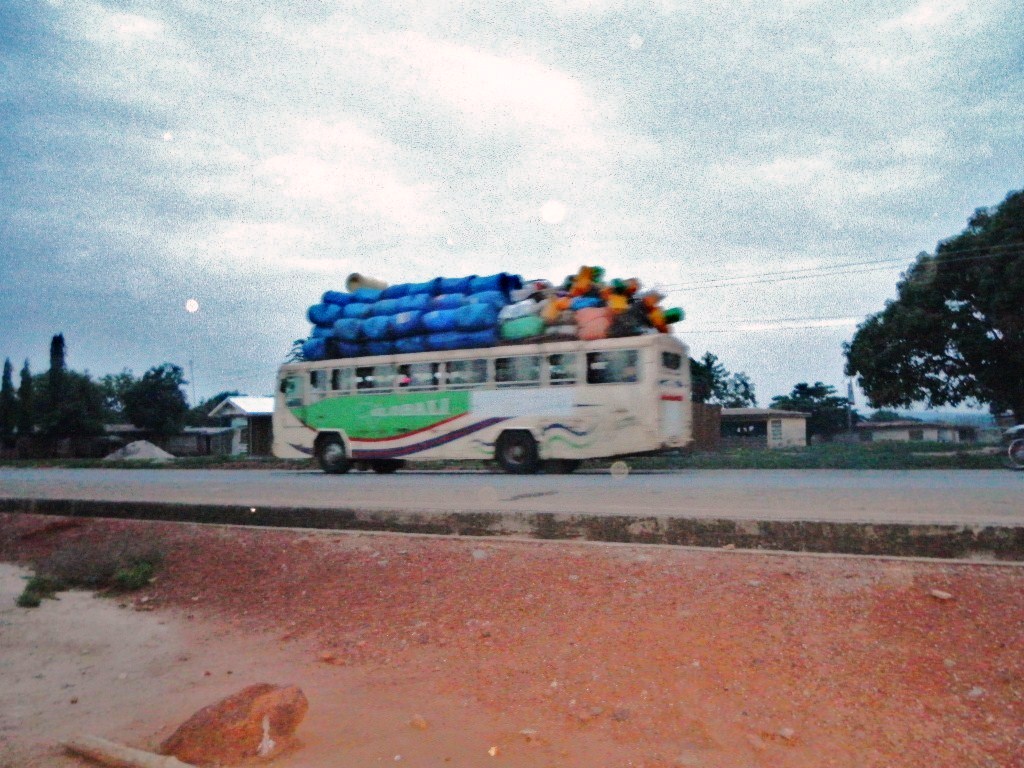
Yes, we got the whole load !!

The contents of this website are mine personally and do not reflect any position of the U.S. government or the Peace Corps.

This road is less than 50 feet from my bedroom and goes north to the Ghana border with Burkina Faso and on to Mali and its famous city of Timbuktu.  Except for the early morning hours between 1 and 4 A.M. when I am told there are armed bandits on the road, it is full of vehicles headed north and south with all kinds of loads; people, food, fuel, cashews, construction materials, animals, and an assortment of items the Ghanians call "pretty, pretty things."  Like the bus in the picture, many vehicles are heavily overloaded and moving rapidly, a dangerous combination.  The blue items on the roof are hard plastic water barrels and the yellow are what I call "jerry cans." Plastic, but identical to what the military used for hauling extra fuel or water.  As this is the wet season, I am sure they are headed to a market.

I have a blue water barrel near the kitchen and bath room areas in the house.   When I arrived I went to the bore hole (well) to fetch water almost daily, using the yellow jerry cans.  More than a couple of trips to fill the barrel.  The caretaker of the house was appalled that others would see me hauling water and so insisted that she and her teenage daughter take care of that chore.  She can fill the barrel with three trips to the bore hole, balancing a large container on her head with wonderful posture and grace.  It is amazing.  I am pleased that they will help me as I am the biggest user of water in the house.  I always want the full bucket bath each evening, water to drink, cook and clean, wash my clothes, and use for the toilet.  Now that the wet season has begun, when the rain starts it is all hands with available containers outside to catch the water from the roof.  A few nights ago I was up early in the morning to quietly use the bathroom, and stumbled over an assortment of pots and pans  full of water in the hall way.  Woke the household.

According to the farmers, the full wet season is late this year.  Maze should be well over four feet high, but is around 18 inches.  We are now getting three to four very heavy rains in a week, mostly in the afternoons and at night.  Some of the rain storms have lasted for hours accompanied by a real display of lightning and thunder.  I am told there should be more to come.  

Sure cuts back on the chore of fetching water.  

On departure day from Washington DC, June 7, 2011, I posted my first blog about my new job.  Time has been full and gone quickly.  Thanks for your interest along the way.  


Thursday, May 17, 2012

Sweet or Salty?


The contents of this website are mine personally and do not reflect any position of the U.S. government or the Peace Corps.

On March 6, 1957, Ghana became the first African colony to be granted independence in the post WW II era.  Prior to that date the country was a colony of Great Britain called the Gold Coast.  Beginning in the 1400's with the Portuguese, who were aware of the gold coming out of this area and moving north by caravan across the Sahara, thought it would be easier to get closer to the source of the gold by a sea route than attempting to control the caravans routes.  Followed by the Dutch, Danish and English, the colony eventually became know as the Gold Coast.  Gold is still one of Ghana's exports, but the photograph shows two that you may enjoy but not know come out of Ghana.  On the left is a cocoa bean taken off a drying tray on my back porch and the right is a cashew fruit with its gray nut pod that I picked from a tree near the school where I teach.    Cocoa is huge.  Ghana is the second largest exporter in the world, most of the product going to Europe and the US for chocolate.   Peace Corps volunteers are involved with Ghanian farmers in improving the logistics management chain of the cashew to expand that desirable product. 

This is the end of the season for both crops, which are grown in groves on the hills surrounding the village and in other parts of Ghana.   Lots of hand labor to harvest from many small groves, then sold to local buyers in the village, and on to larger cooperatives and exporters.  

Like some other countries I have lived, Ghana is full of contrasts.  All adults seem to have a cell phone and use it everywhere,  frequently.    Vehicles of all types are in abundance and have already overwhelmed the capacity of the roadways, particularly in cities, as well as the maintenance required to keep them up.  Building construction is everywhere, some underway, others stopped and still others seemingly abandoned.  Western styles are popular, mixed with the very colorful, traditional dress of the Ghanian women, and the noble looking robe worn on special occasion by some of the men.   Seems little is thrown out as I have seen yards and yards full of used vehicle engines, next to yards full of auto doors.  Never get bored looking out the window on a bus ride.

I cannot afford a stash of  chocolate or salted cashews at my house and certainly not gold.   When you enjoy the beauty of gold or the delicious taste of  sweet chocolate or salty cashews, hope you will be reminded of this interesting country where I live.

Tuesday, April 24, 2012

Stayn' Alive


The contents of this website are mine personally and do not reflect any position of the U.S. government or the Peace Corps.

 I am very grateful that my health has continued to be excellent since coming to Ghana.  From the detailed selection process, through the demanding training and now well into my two years of service, the Peace Corps has been attentive to my health and well being.   Peace Corps, Ghana has two Medical Doctors on staff, both have visited my site while traveling through the Region.  Most of the circumstances at the school where I teach are mandated by the Ministry of Education, but showing up ready to teach each day is one that I have some degree of control over. For the first two school terms (30 weeks) I have been healthy and  missed only 6 days of teaching and those were to meet Peace Corps' responsibilities.   Many of my fellow teachers are not so fortunate and have absences due to sickness. 

For the first seven months of my service, I ate Ghanaian food, prepared by Ghanians almost exclusively.  A few bouts of stomach distress, a few "no thanks" on seconds, and the loss of over 30 pounds are the outcomes of that period of my stay.  I am told the loss of weight is common for male Volunteers in Ghana.  Common for females to gain.  Not sure of the reasons, but for me,  I walk much more frequently, have had almost no sweets, drink a lot of  water, do some exercise each day and it has been blazing hot.   

The Ghanian diet in the areas where we trained and  now I live, is made up mostly of starch-based staples (cassava, yams, rice, coco yams, plantains) cooked in various ways and served with a soup that often contains fish or chicken and vegetables that are in season.  It is filling, can be very spicy, and frequently tasty.  Most often eaten using your fingers.   Fruits and vegetables are seasonally fresh, not often served as a separate dish, but usually cooked in the soup or eaten as a snack during the day.   Mangoes, avocados, pineapples, and papayas are currently sold all over the market and along the streets.    However, I believe most Volunteers miss the variety and types of foods common in their region of the States.  I know I do.  My list varies from time to time, but today it would include: a cheese burger from Five Guys; roasted peppers from a restaurant near Pittsburgh called Ricco's; and crab cakes from almost any place along Chesapeake Bay.  

 During my first school break in January, I completed the kitchen in the house where I live.   From the picture you can see it is not elaborate, but sufficient.  I started from a bare room,  built the counters and shelves, and purchased an electric kettle, a small gas stove, a toaster oven and variety of plastic food containers.   The stove pipe looking item at the far left is a water filter to allow safe drinking water from the well and rain water off the roof.  First meal from the kitchen was packaged noodles and have expanded from there.  I am holding a fresh pear (avocado) and poo-poo (papaya) that I will eat this afternoon.  My attempts at guacamole have not been endorsed by the Ghanians, but I find it acceptable with some chips I found in the market.  Add tacos to my list of food I miss.

Cooking is a time consuming deal for the Ghanian caretaker and her family as it is mostly done outside, over a wood or charcoal fire in a pot.   Most things growing out of the ground are reasonable fresh or dried, but fish is dried and has not seen water for some time.  At my house, the evening meal is started well before sunset and is eaten in the dark.  Lots of pots and pans to clean up at the end of the day.  Adjustments are made for the more frequent rains as we head into the wet season.  Cooking for myself has also required some adjustment in scheduling my time as going to the market, preparing the food, and cleaning up takes a lot more time than in my kitchen in Virgina.  I continue to be grateful for the pleasure of preparing my meals.


I have two place settings in case you stop in for a home cooked meal.  You are always welcome.

Monday, April 9, 2012

I go farm!


The contents of this website are mine personally and do not reflect any position of the U.S. government or the Peace Corps.

My village is in one of the most productive food growing regions in Ghana. The country's largest outdoor produce market is in a nearby city and serves buyers from all over Ghana as well as neighboring countries. Most of the villagers where I live are farmers. On arriving and hearing the phrase, "I go farm", in my mind I imagined the person heading to their residence, but it means exactly, "I am going to work my land."

Today is the Monday after Easter and is a part of a four day holiday that starts on Good Friday. School is out. This morning the caretaker and her family announced, "I go farm!" Since it had rained through much of the night, the morning was cool, with moisture still in the air and an overcast sky, it was the perfect day to "go farm" with them. It didn't take long for me to know that did not sound like a good idea to them: we must walk far; it is going to rain; it is hot; it will be very late when we return; maybe next time. Not wanting to push the issue, I put down my cutlass and wished them a productive day. After grading some school papers, cleaning my room, and just puttering around, I decided to head out on my own and see who was farming.

There are two dirt roads heading up the hills into the local farm land, one I had hiked before. So with my backpack, camera and plenty of water, I took the other road out of town headed to "farm." About twenty minutes into the journey, I joined the group you see in the picture. They are not on a holiday, walk about, but headed out "to farm", carrying containers of water on their heads, babies on their backs and the basic all around farming tool, the cutlass. I certainly amused them, first of all by just being there and most of all by my bad "Twi", the local language. When they headed off on a small side trail, I continued on the main trail for another two hours.

Most of the farms are small plots of land, worked entirely by hand with mostly a cutlass and a sturdy tool that looks like a cross between an axe and a large hoe. A sharp cutlass is needed to farm as the "bush" is a ready invader and can quickly take over cleared area. During my four hours I did not see a large number of farmers, but each time I stopped, I could hear the slash of a working cutlass.

Some farmers were harvesting cashews, a difficult task as they must wait till the cashew drops from the tree, pick it up, pinch off the nut pod that is just below the fruit and place in a bucket. From there the nut pod is dried in the sun, sold to a local buyer, and either exported or processed in Ghana. About 6 more steps are necessary, some by hand, before they are ready for consumption. Thus the price, even in Ghana.

Other farmers were planting peppers (red hot), maze and cassavas. The trees along the trail were full of mangoes, avocados, papayas, and some other fruit I did not recognize, many marked with a red piece of cloth indicating not for sharing.

Fours hours later, the time and water had gone quickly, met more residents of the village, saw and learned some new things, but did not use my cutlass or "go farm." Maybe next time.


Sunday, April 1, 2012

A University of Florida Man Needs no Introduction


The contents of this website are mine personally and do not reflect any position of the U.S. government or the Peace Corps.

There are at least five graduates of the University of Florida in the current group of Volunteers assigned to Ghana. This person is not one of them, he is the Headmaster of the Junior High School where I teach. Normally more professionally dressed, this day he came to work wearing a Florida Gator shirt not knowing I am a graduate of that University. Could not resist a picture of U of F's world wide fans. In the background you can see our school building and the chairs and table that are part of the faculty office and lounge situated under the mango tree.

I enjoy working for this Headmaster as his primary interest for the school is providing an opportunity for the students to successfully complete an education and move on to Senior High and perhaps after to Technical School or University. He expects us to support him in that objective and demands discipline from the students and performance from his teachers. Although this assignment is a real challenge for me and at the end of most days am ready to sit in a soft chair and take on some refreshments, I am grateful for my fellow teachers and his leadership.

We are just a few weeks away from the completion of the second of three 15 weeks terms making up the academic year. I continue to teach mathematics and computer skills. Except for the concepts and principals of mathematics, everything else is a new experience. The government school system is administered throughout Ghana by the Ministry of Education and even though the school where I teach is called the Roman Catholic, Junior High School, curriculum, term dates, teacher assignment, teaching syllabus and most other systems are decided by the Ministry. The village also has a Seventh Day Adventist school, an Islamic School and a Government School, all controlled by the Ministry. There are also private primary and secondary schools throughout Ghana.

I am looking forward to the school break and perhaps some sightseeing. Let me know if you need a University or Team shirt or shorts as the market has a wide assortment. Go Gators !!